Global Logistics Trends Transforming How the World Moves Goods
The global logistics industry is in the middle of its most significant transformation in decades. From the size of the vehicles carrying containers to the technology managing ports, the global logistics trends emerging right now will reshape supply chains for the next 20 years. Understanding these shifts isn’t just interesting — it has direct implications for how businesses plan their logistics infrastructure.

At Shipping Containers Now, we watch these trends closely because they influence the containers available in the market, their specifications, and ultimately what’s best for our customers.
The Most Significant Global Logistics Trends in 2026
Trend 1: Longer Combination Vehicles (LCVs) on Road Networks
Several European countries and Australian states are now permitting “road trains” — articulated trucks pulling multiple container trailers in a single combination up to 32 metres long. These Longer Combination Vehicles (LCVs) are one of the most impactful global logistics trends in road freight, reducing the number of truck movements required per tonne of cargo by up to 40%. Less trucks, less fuel, less road wear — the benefits compound quickly at scale.
Trend 2: Mega-Vessels and Port Capacity Pressure
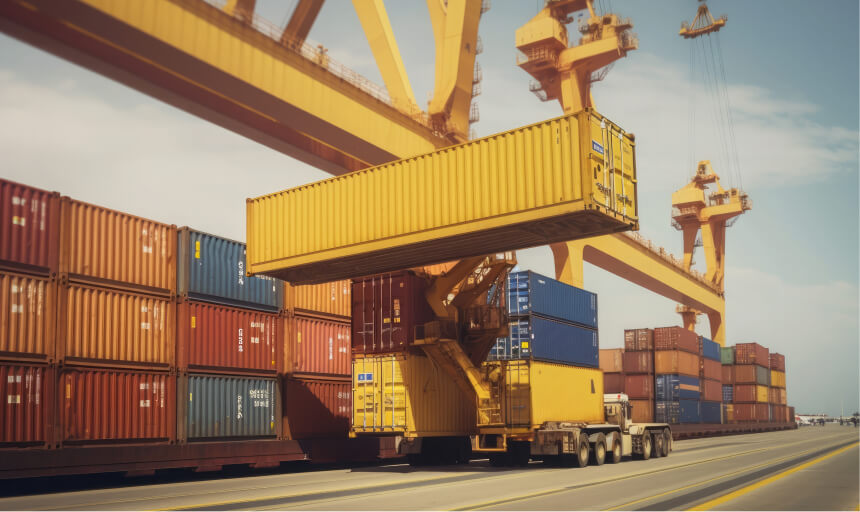
The world’s largest container ships now carry over 24,000 TEU (Twenty-foot Equivalent Units) — equivalent to a train 44 miles long. These Ultra Large Container Vessels (ULCVs) generate massive port congestion spikes when they arrive, because terminals must process thousands of containers in a compressed timeframe. This is driving one of the key global logistics trends: massive investment in automated port craneage and AI-driven berth scheduling to smooth throughput. View our container inventory to understand the specs that work within these evolving global systems.
Trend 3: AI and Predictive Analytics in Supply Chain Management
Perhaps the most transformative of current global logistics trends is the application of artificial intelligence throughout the supply chain. AI is now being used to predict port congestion up to 96 hours in advance, optimise container routing to avoid empty repositioning, and dynamically re-plan shipments around weather events or geopolitical disruptions. The result is a measurably more resilient, efficient, and lower-carbon logistics network.
Trend 4: Near-Shoring and Regionalisation of Supply Chains
The COVID-19 pandemic exposed the fragility of ultra-long, single-source supply chains. One of the most durable global logistics trends that emerged is near-shoring: shifting production and warehousing from distant low-cost countries to nearby regions where supply chains are shorter, more controllable, and more resilient. This is increasing demand for flexible local storage and distribution infrastructure — exactly where 40ft containers excel as modular warehousing units.
Trend 5: Electrification of Port and Depot Operations
Major ports including Rotterdam, Hamburg, and Singapore are mid-way through full electrification of their yard operations — replacing diesel reach stackers, straddle carriers, and terminal tractors with battery-electric equivalents. This decarbonisation of port operations is a significant global logistics trend with implications for where emission-intensive container handling concentrates and how supply chain carbon is measured and reported.
What These Trends Mean for Container Buyers
The combined effect of these global logistics trends is a larger, more sophisticated, and ultimately better-connected global container fleet. For buyers of used containers, this means a continued strong supply of well-maintained, recently retired units entering the secondary market as shipping lines update their fleets to meet new efficiency and environmental standards.
Browse our current container stock or get in touch with our team to discuss how these trends affect the right container spec for your needs.